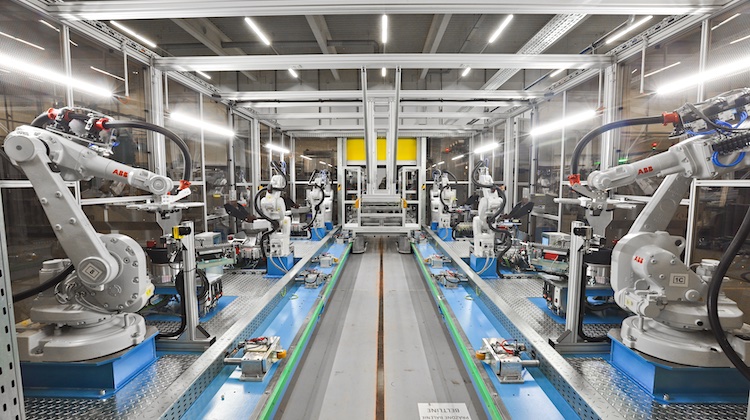
KraussMaffei says it’s developed intelligent robots that can assemble the interior trim for two vehicle doors in just 40 seconds, including inspection and positioning checks.
The system was developed at the company’s Trimming Technology Center in Viersen, Germany, for Yanfeng, a Tier 1 supplier that produces automotive interior components.
“In our Trimming Technology Center, we can do almost everything that needs to be done after the actual plastic part has been manufactured,” Marcel Joppen, the plant’s manager, said in a news release. That includes installing map pockets, armrests, recessed grips and other components.
How It Works

In the process described by KraussMaffei, the interior door panel acts as a base carrier and is moved past three assembly stations. At the first two stations, components are screwed onto the panel. At the third, clips are added that will later be used to attach the finished trim panel to the metal door.
To increase efficiency, two door panels at a time are placed into an aluminum frame on a self-propelled load carrier. As the carrier enters the assembly tunnel, a barcode scanner identifies which door variant is being processed and which equipment it requires. Once the panels are manually clamped into position, a camera system checks their exact alignment to make sure the screws will be placed correctly.
This is where much of the speed comes from. KraussMaffei says the camera system takes 350 milliseconds to capture an image, evaluate it, and calculate the precise position of the parts, including translation and rotation. Components such as the armrest, recessed grip and map pocket are then attached using ABB 1200-7-70 robots, which retrieve 18 screws per door from a dispenser. Because of their shape, the screws cannot be blown into place and instead have to be individually handled by the robots. Even so, the company says the cycle time for six screws, including camera measurement, is 24 seconds, with three robots working on each door.
The next step is adding the clips that will later secure the panel to the door. While the carrier is still moving, an ABB 1600-145-10 robot removes nine clips in 13 seconds using a vacuum gripper. A laser sensor then scans the clip positions and measures their depth in nine seconds, accounting for small differences in how the panels are positioned in the frame.
The clips, which include rubber sealing lips, are installed in 1.4 seconds per piece. According to KraussMaffei, the total cycle time for this step, including camera and laser measurement, is 29 seconds.
When all steps are combined — including movement between stations and clamping and unclamping the load carrier — the full assembly line achieves a cycle time of 40 seconds, producing two fully assembled interior door panels using a total of eight robots.
The Future of Auto Manufacturing
KraussMaffei says the three-station system can be expanded if additional process steps are required. The company also offers automation solutions for other post-processing tasks such as punching, milling, deburring, laser cutting, ultrasonic cutting and welding, flame treatment and scoring. Scoring is used, for example, to weaken material in airbag areas so it opens correctly in the event of a crash.
The Trimming Technology Center in Viersen has focused on these kinds of processes since 2005 and now employs more than 75 people. While most of the work is for the automotive industry, KraussMaffei says the expertise developed there is increasingly attracting interest from customers in the medical technology sector as well.
For Yanfeng, the project reflects a broader collaboration with KraussMaffei as it works to meet the demands of vehicle manufacturers.
“KraussMaffei is an important strategic partner for us,” said Martin Kerestesi, plant manager of Yanfeng International Automotive Technology Slovakia at their Namestovo, Slovakia, site. “Together, we do everything we can to meet the high requirements of our OEM customers in the best possible way.”
I don’t know about you, but “best possible way” sounds like a gross understatement. These robots can finish assembling two door panels in less time than it takes me to find my power screwdriver. That’s mind-blowing!
Recent Comments